Showing posts with label environmentalism. Show all posts

Thursday, June 20, 2013

Singapore So Polluted I Can't Leave the House

From the Straits Times
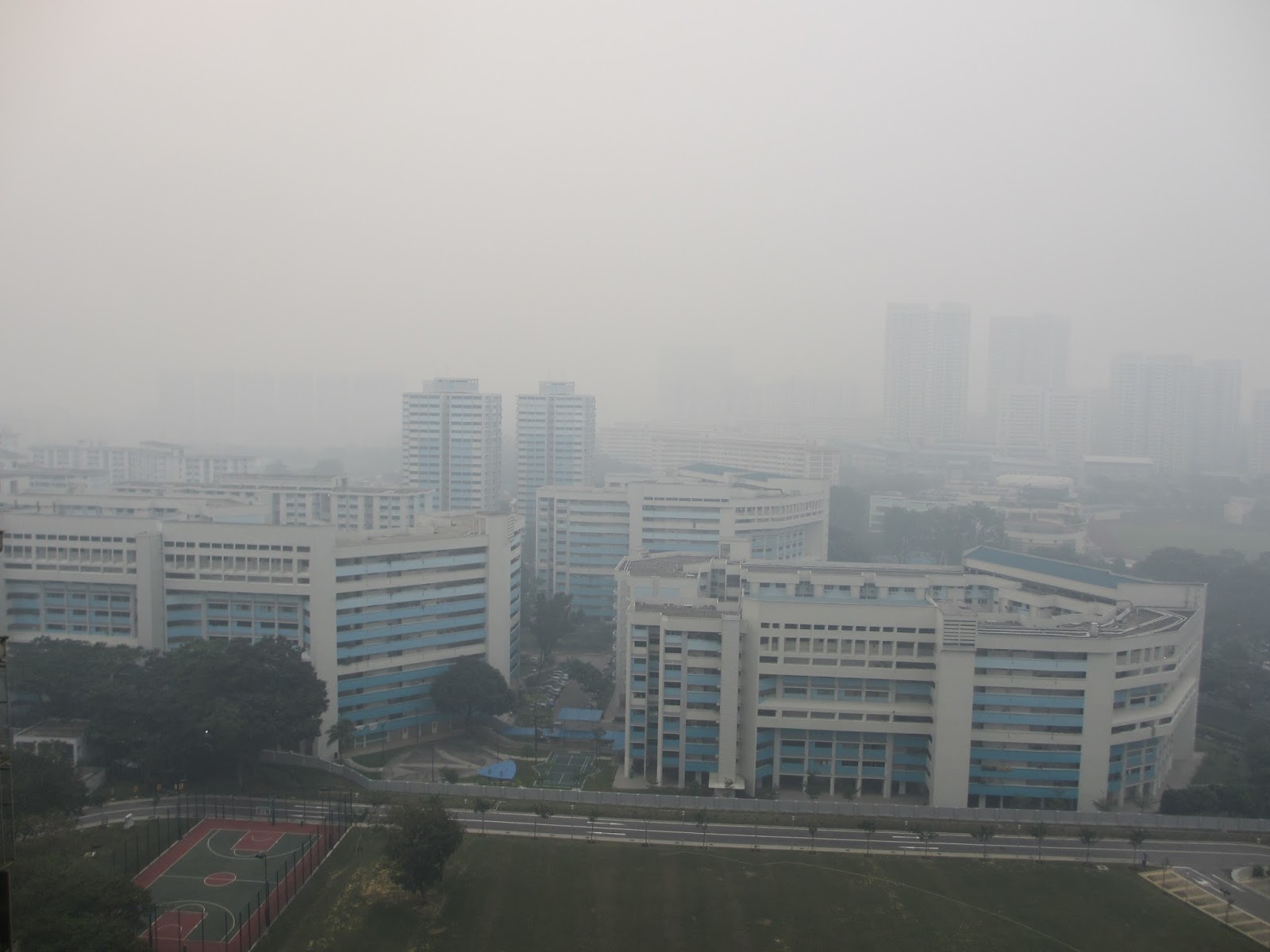
Air pollution has officially reached "hazardous" levels here in Singapore. The government is recommending that children and the elderly "remain indoors and keep activity levels low": everyone is supposed to avoid outdoor physical activity.

Outside our house, at around noon
This is totally NOT awesome. Not only does the air smell bad, breathing it burns my throat and nose. The sky is permanently darkened (you cannot actually see the sun, let alone blue skies or clouds), which gives the entire city a rather ominous, gloomy feeling. I keep imagining that I am being poisoned and will suddenly drop dead like those poor people in Pennsylvania (whose fate spurred the creation of the Clean Air Act).

Even more depressing is the reason behind the pollution. It has nothing to do with Singapore (whose government is quite responsible): the haze is caused by farmers (illegally) burning down the Sumatran rainforest. So not only am I being forced to live in an unhealthy environment, but it's being caused by the wanton destruction of endangered animals (pygmy elephants! orangutans!) and an irreplaceable natural environment.

Since the Indonesian government's response is to accuse Singapore of "acting like a small child" as a result of its complaints on the issue, I don't see the situation improving any time in the near future.
Gross! When can I flee?

Saturday, December 31, 2011

The Omnivore's Dilemma

I had heard quite a bit about Michael Pollan before reading this book, mostly extremely positive things, to the point that I felt dubious about him out of contrariness. Also, I knew that he is one of the patron saints of eating food produced on small, local family farms (a method of food production that I have a lot of objections to), so I came into the book with sort of a chip on my shoulder.

I loved this book. It was one of my top ten this year (I usually read about 150 books/year, so that is really good). I talked it up so much that I convinced both my parents to read it. I also went back to the library and got another of his books (In Defense of Food), even though it's a diet book and I usually hate those. It's even made me feel (somewhat) enthusiastic about both small family farms AND hunting (which is a huge stretch, let me tell you).

So why did I like this book so much? It's divided into three sections. The first covers mechanized, industrial agriculture (how basically all food in the US is produced). I had only a cursory knowledge of this industry, and found his discussion totally fascinating. Did you know that chemically, Americans are basically corn chips because most of our food is just processed corn in various forms? Or that 125,000 acres of North America are covered in corn (twice the size of New York state, and visible from space)? I loved learning about the hidden processes behind the food we eat, both animal and vegetable. B liked this section too (or at least the parts I read to him) because it discusses chemical fertilizer, which is his latest research interest.

The second section is about organic farming, both the large-scale kind (which is very similar to traditional agriculture, minus the heavy chemical use) and the small-scale family farm kind. Of course Pollan thinks the small scale kind is vastly superior, and its perfection is represented by the farmer Joel Salatin. Salatin is certainly an interesting character, but also an ignorant crank on all topics not involving farming, so I found Pollan's hagiographic descriptions of him hard to take at times. Nonetheless, learning about the organic farming industry was also fascinating, and so were Pollan's lyrical descriptions of Salatin's farming operations. There is something very beautiful about the concept of a perfectly contained ecosystem run and maintained by humans, where everything is sustainable and all waste is no longer pollution, but is recycled back into useful products. It's like one of those cool little EcoSpheres, except bigger and actually societally valuable. I was almost ready to go out and join a CSA by the end.

The third section is on hunting (mostly) and gathering (tangentially; he does gather mushrooms but other plant species are neglected). It's the first account of hunting I'd read written by someone with a similar background to my own, and made me understand why people like something that had previously struck me as barbaric and vaguely distasteful: it's completely thrilling. I can believe Pollan's theory that hunting appeals to something vital and basic to human nature. Reading this chapter definitely changed my opinion about hunting (and hunters) for the better, in addition to teaching me something about the mechanics and skills involved.

Things I liked about the book:
--Well-researched.
--While (like all authors) he does have an agenda, it is not usually so strong as to overpower the narrative. He tries to consider both sides in a fairly balanced way.
--The author is self-aware and honest. In a book like this, which is partly memoir, this is very important.

Things I didn't like:
--He definitely did a lot of research. However, he is basically a journalist, not a scientist or an economist, and sometimes it shows. In particular, he is very weak on following the economic consequences of his recommendations to their logical end (like what would actually happen if the average American spent 20% instead of 10% of their income on food).
--The book is very provincial. There is basically no discussion on any food system beyond those in the US. Because the US in fact has a very unusual food system when considered globally, this is a big weakness. This is typical in American books, but as Pollan tends to speak in global terms, he really needs to expand his horizons a bit.

So will I be changing anything? I am considering. His arguments for buying organic were convincing. I had always dismissed buying organic produce as a waste of money, but I may reconsider now. I may also be buying more humanly produced eggs (though I admit this is mostly just because I am sentimental, not because his argument is really that good). I won't be going hunting (ever) but I am more sympathetic and therefore supportive to people who enjoy it. I still am pro-industrial agriculture, chemical fertilizer and agribusiness though, partly because I feel Pollan is very naive about the alternatives. I would love stricter regulations in these areas, especially from an environmental perspective, but I thought that before reading this book.

Overall, I would strongly recommend The Omnivore's Dilemma to anyone interested in food, nutrition, environmental issues, animal issues, eating, or the modern world.

Monday, November 23, 2009

Why Environmentalism Is Good

Environmentalism gets a bad name because often the people who support it are wacky ideologues (fanatic vegans, slow foodists, and Greenpeace activists come to mind). Also, it's become associated with things like saving the darter snail and buying overpriced food from chichi supermarkets, both things easy to mock. But actually virtually everyone ought to be an environmentalist, and if you aren't, you are probably on the side of evil (and just don't know it).

After living in China for a year, I am much more of an environmentalist than I used to be. This is because I could see the damage unchecked industrialization first-hand. In the US, we are protected since our environmental regulations are relatively high and usually enforced, and the population is not that dense, meaning the environment is not as stressed.

In China, on the other hand, in many places you will never (literally) see the blue sky or the stars. In some places, the air can be so thick it looks smoky all the time and most of the population has hacking coughs. Near Shanghai, all the water sources are so polluted that the government is spending billions of dollars to run a pipeline to the middle of the very bottom of a large lake, as it's the only place where the water is clean enough to be used for drinking (this is after treatment: elsewhere there are so many contaminants that even treatment won't help). They say that breathing the air in Shanghai is like smoking two packs of cigarettes a day (I developed interminable coughs there, so I believe it). When you go outside, you will often become coated in grit by the time you get home. And this is at a time when according to everyone, Shanghai is much less polluted than previously (since many factories have relocated due to rising wages and land prices).

And who benefits by making the environment disgusting and unhealthy? The rich, who keep all the profits from the industrial processes (and their political cronies/spouses, since in China big businessmen and government officials are basically the same people). Of course, it's also the rich who can afford to buy bottled water, filtration systems, and the like. Meanwhile, the poor are left with a ruined environment and no recourse.

Conservatives typically make an argument like, "Well, they are poor and don't value a clean living situation as much as we would. They are choosing wealth-creating industrial growth over enviromentalism." What this argument fails to acknowledge is:

1. The poor often would prefer a cleaner living situation but are ignored. For example, in China they frequently have environmental-related protests. Typically, the case is something like: a new factory opens and pours its waste products directly into the nearby river; this ruins the water, fish, and crops; the peasants protest against the factory's behavior; they are swiftly repressed by the government (either through intimidation or violence); this is not on the news due to censorship; the factory continues its behavior. This is way more common than I think most Americans are aware of.

2. Pollution generated by a factory or mine is going to affect everyone in the area, regardless of the economic benefits they derive from the pollution's source. Therefore, while some of the poor (those employed by the factory, for example) might decide that the pollution is worth it, everyone else, from infants up is going to be equally affected. I don't believe it's just for some people to make a decision which affects all people. Even if you put it to a vote, this would be problematic since children (those who would be most affected) would not be able to vote.

3. Usually people, especially if they're poor, are not aware of the true costs of their decision. This is because a. we don't know very much about natural processes (for example, the effects of global warming are not clear or known, in addition to the fact that many people disagree about if/why/how it is even happening); and b. those with information in this situation have a strong incentive to lie (the company doesn't want to tell people that the chemicals they are using cause cancer since this would cause them troubles).

Since industrialization is crucial to the functioning of any modern society, what is thus essential is careful regulation and study of the effects of industrial processes: in other words, environmental agencies, laws, and scientists. These groups act as watchdogs for the benefit of the public, and protect them against wealthy businessmen and large corporations (since producing a significant level of pollution is usually only possible for a large company).

Environmentalists are really championing the "little guy" against the MAN (leaving aside the question of what our responsibilities are to animals and plants). Anyone who is not in favor of environmental regulation is therefore in favor of supporting the unscrupulous wealthy against the hard-working poor (whose livelihoods may very well be destroyed if they can't fish/farm), children, and those with health problems.