
Showing posts with label taiwan. Show all posts
Showing posts with label taiwan. Show all posts
Friday, July 11, 2014
Flashback Friday: 2002 Kinmen, Taiwan

Sunday, August 26, 2012
The Ghosts Are Coming
Singapore, like other Chinese-influenced countries, celebrates Ghost Month. It's not an official holiday, but is popular among the general population. This festival was also big in Taiwan (in fact, it was even a bigger deal than it is in Singapore; the Taiwanese are very religious generally speaking).
According to traditional Chinese belief, there is not a distinct line between the dead and the living. (A little Taiwanese student of mine explained it to me thusly: "You shouldn't be scared of ghosts, they are just dead people.") Once you die, you go to the Underworld, which is very much like this world, complete with officious bureaucrats, paperwork, and social rankings. There you are judged on your behavior during this life, and punished or rewarded as you deserve by the Underworld's staff (which, because it's the Underworld, consists of ogres and the like).
Assuming that you aren't busy being punished, you may be given an official rank yourself and gain influence over affairs. You can use this influence to help people on earth (by improving their career success or exam results, for instance). You can also harm them if angry, by making them ill and causing misfortune.
During Ghost Month, the dead are allowed to leave the Underworld and come into this world. Therefore, the festival is about placating these ghosts to make sure they use their influence to your benefit. This is mostly done through bribery, or giving offerings, which include certain kinds of food, incense, and most importantly, paper items. The most popular is paper currency, or 'hell money' (yes, that's the name, printed right on the bill), which the ghosts can use to buy things in the Underworld. A huge variety of other paper items are also available: credit cards, clothes, beer, cigarettes, jewelry, cars, houses...pretty much anything people on Earth might like.
In Taiwan, it's considered an unlucky month, since everywhere is thronged with invisible, potentially malevolent ghosts, and so people try to avoid starting new ventures or taking trips (meaning hotels and tourist destinations are empty, nice for traveling Westerners). The air is smoky with burning paper money and incense, and people put out little shrines outside their houses (since you don't want the ghosts to go inside!).
So far in Singapore I haven't seen as much activity (though the official date of the festival is the 31st, so I will have to wait), but even so there are offerings about. They also celebrate with a unique tradition: kitschy song and dance shows called getai. Maybe I will get a chance to check one out: I will have to see.
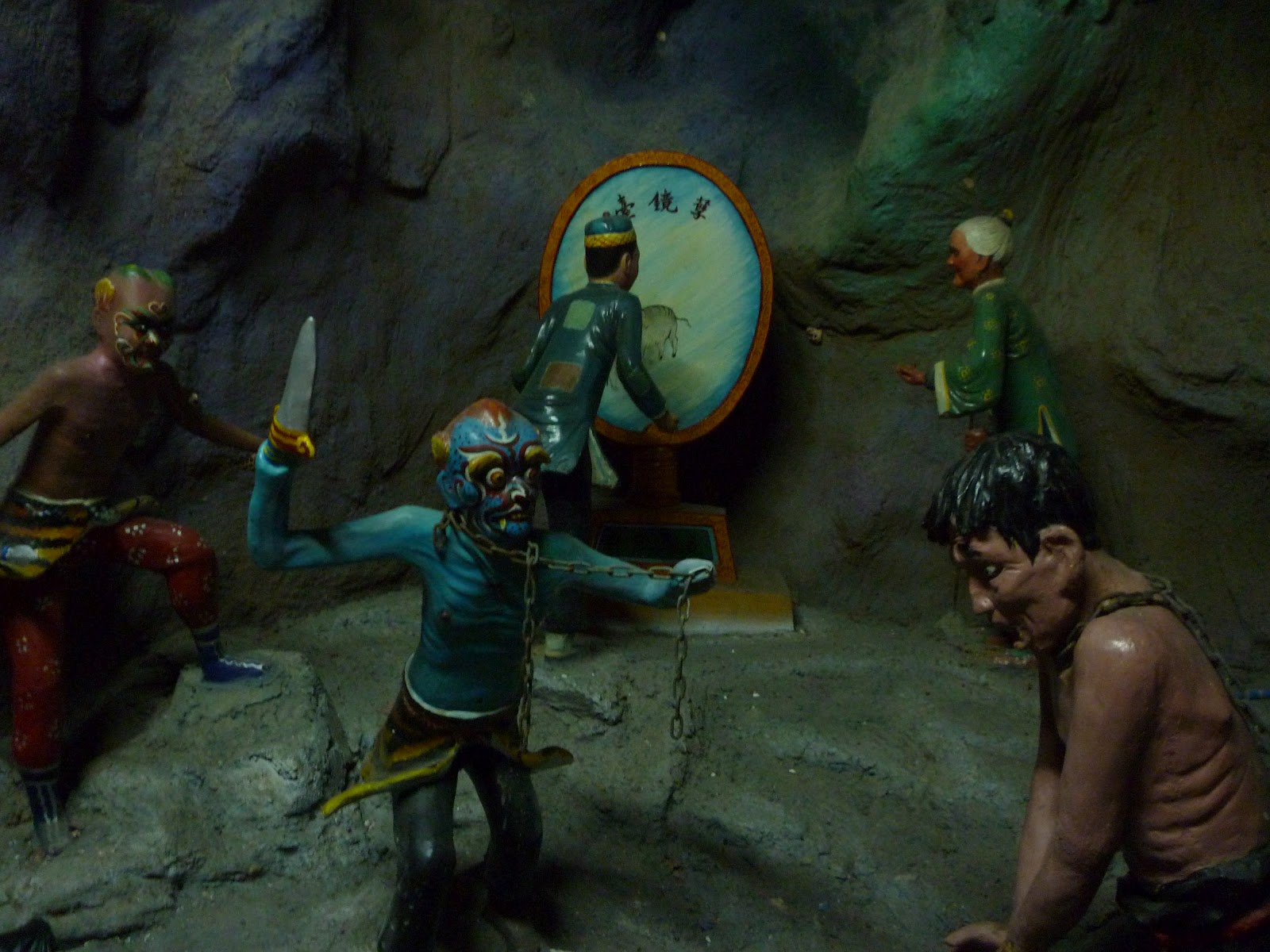 |
| Processing the dead: some look in the mirror to forget their pasts (and be reborn), some are punished. Note ogre spirits at work. |
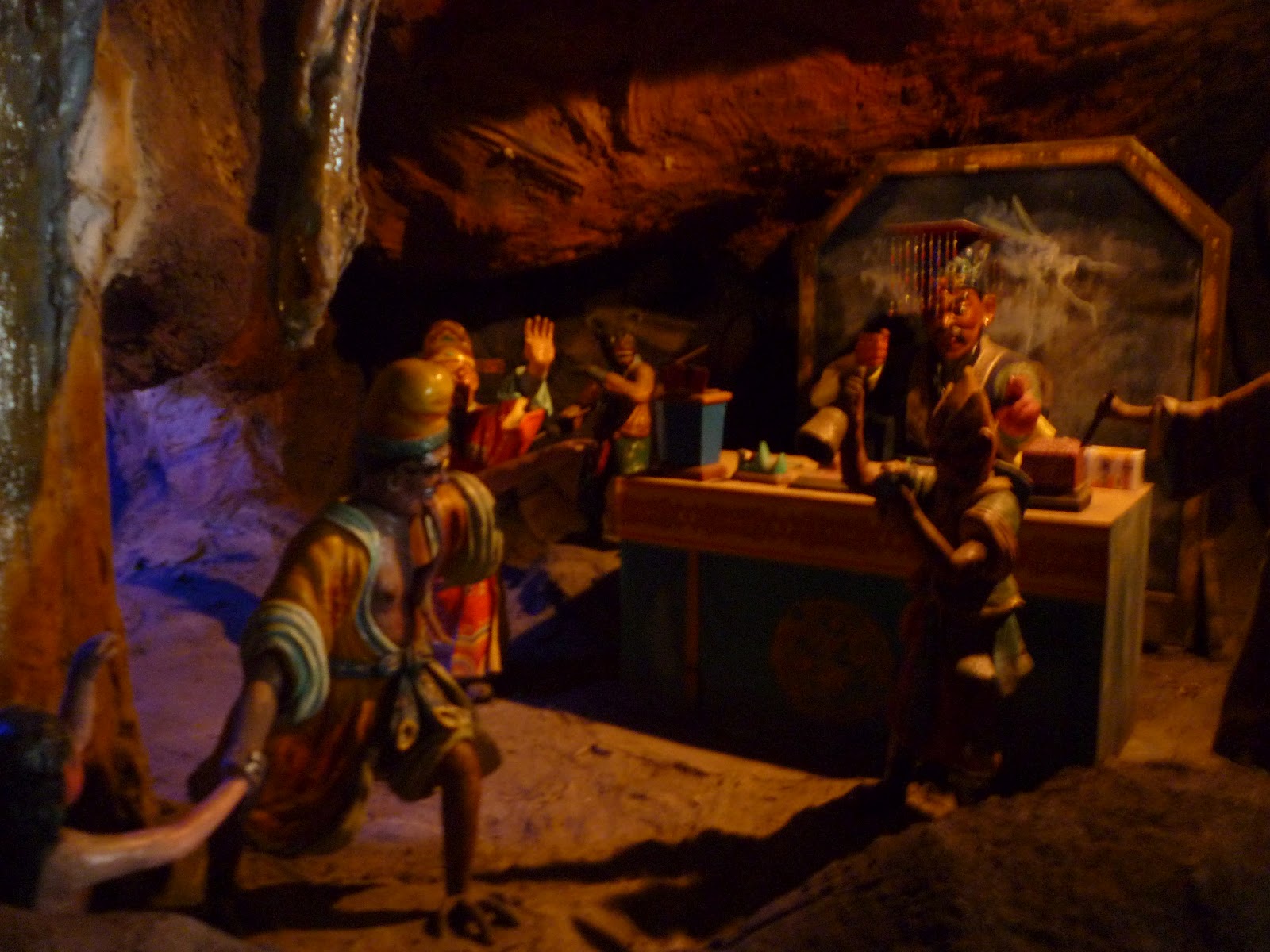 |
| The dead being judged by an Underworld official |
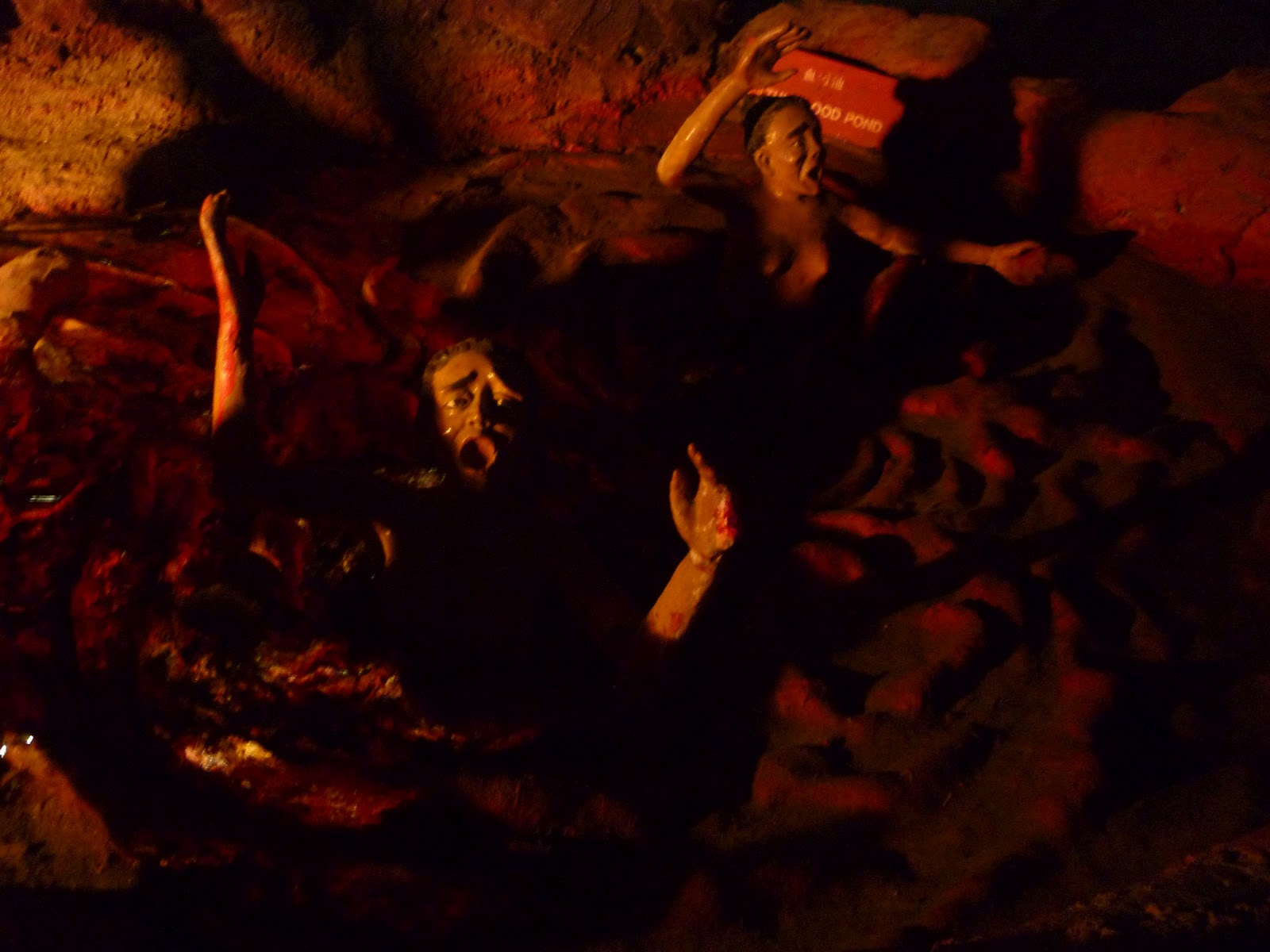 |
| Bad people being punished (in a pit of blood) |
 |
| Hell money |
 |
| Offerings near our house |
So far in Singapore I haven't seen as much activity (though the official date of the festival is the 31st, so I will have to wait), but even so there are offerings about. They also celebrate with a unique tradition: kitschy song and dance shows called getai. Maybe I will get a chance to check one out: I will have to see.
Saturday, November 26, 2011
I Miss Taiwan


Progress:
--Exercise: 1 hour gym.
--Diet: Breakfast: Kix with soy milk and golden raisins; Lunch/dinner: Hamburger on foccacia with lettuce and tomato; butter lettuce salad; Snack: gummy bears; Drinks: cranberry juice
--Other: Did not drink enough water
Saturday, April 16, 2005
Preparing to Return Home
I have definitely decided to go to SF State for the next two years, because it's so much cheaper than the other schools (and the school in LA sounds like a rather mediocre school for the rich and sun-loving). I will be in the Bay Area for the next few years, which I am looking forward to.
Things in Taiwan are fine. I am still studying Chinese, which I enjoy, and teaching the little children, which is rather boring. I am looking forward to the time when I won't have to force unwilling youngsters to do grammar anymore. At least I have really improved at teaching, so that it's not too hard to do anymore.
It's hard to believe that I will be leaving Taiwan forever in less than a month. I will miss some things about it a lot, like the cheap, delicious food and convenient opening hours (where else can you buy furniture at 11 pm?). The public transportation is really good here too.
Things in Taiwan are fine. I am still studying Chinese, which I enjoy, and teaching the little children, which is rather boring. I am looking forward to the time when I won't have to force unwilling youngsters to do grammar anymore. At least I have really improved at teaching, so that it's not too hard to do anymore.
It's hard to believe that I will be leaving Taiwan forever in less than a month. I will miss some things about it a lot, like the cheap, delicious food and convenient opening hours (where else can you buy furniture at 11 pm?). The public transportation is really good here too.
Tuesday, December 14, 2004
Taipei Update
Things have been extremely hectic here of late, due to college applications, the start of a new school semester (with a really strict and difficult teacher) and new students to teach. I am now tutoring a student at Taipei American School (a private school taught all in English) in American History. Her family is extremely wealthy, owning a three-floor apartment in the ritziest area of Taipei, and so they pay me about 33 dollars an hour to do this (which is about $14 more than I usually make). She's a nice girl, and easy to teach, although her mother always goes on and on about how stupid she is. I'm not sure if this is just Chinese parenting or her mother really thinks so. Her father is rarely home; according to our Taiwanese friends, most wealthy Taiwanese men have at least one mistress, so maybe that's why. In any case, it's interesting.
Christmas in Taipei is upon us, such as it is. While Christmas has recently become trendy here, they don't really understand what they're doing. For instance they have installed multiple large Christmas trees at the nearby shopping center, all emblazoned with Johnny Walker (the whiskey) advertisements. Also people buy presents here, but they only buy them for their friends (because if you buy presents for parents, they must be extremely expensive and lavish, out of filial duty). My teacher was surprised to learn that people in America think Christmas is mostly a family holiday. Actually the Chinese aren't much for presents in any case. They prefer to give each other money, in special red envelopes (white ones are only for funerals). Very practical!
Christmas in Taipei is upon us, such as it is. While Christmas has recently become trendy here, they don't really understand what they're doing. For instance they have installed multiple large Christmas trees at the nearby shopping center, all emblazoned with Johnny Walker (the whiskey) advertisements. Also people buy presents here, but they only buy them for their friends (because if you buy presents for parents, they must be extremely expensive and lavish, out of filial duty). My teacher was surprised to learn that people in America think Christmas is mostly a family holiday. Actually the Chinese aren't much for presents in any case. They prefer to give each other money, in special red envelopes (white ones are only for funerals). Very practical!
Saturday, November 13, 2004
Taiwanese Hot Pot
Taiwan has quite a number of Indians living here, working in the computer industry. I often see them out and about, the women wearing beautiful saris and their husbands in standard office dress. Two of my little students (Dhwani and Khyati) were Indian, from Gujarat. It must be difficult to be a Hindu in Taipei though, because almost all the commonly available food has meat in it. In fact, the local English paper recently ran an expose on ostensibly vegetarian food, to discover that over 60% of it contained some sort of meat product. Ooops!
Last night I went out to eat with my boss and co-workers from Uncle Jason School. Jason (the Chinese boss) took us out to a Mongolian hot pot restaurant. Hot pot restaurants are incredibly popular here. The idea is that in the center of the table boils a big pot of water. You order various uncooked foods, such as meat, vegetables, tofu, duck blood, quail eggs, etc., and then boil them yourself in the pot, removing them when you are ready to eat. The whole process is very slow, so that dinner typically takes at least two hours to complete. I don't usually like hot pot, because when I go out to eat, I want them to cook my food, but this restaurant was actually really good. The water was heavily spiced, with cumin, chili peppers, garlic and various Chinese spices which are supposed to have medicinal qualities. Supposedly this is the same recipe used by the Mongolian emperors many years ago. My boss also broke out the (practically obligatory) expensive, imported whiskey. I had to drink it even though I dislike whiskey, as he kept telling me, "You have to catch up!" This is what a polite Chinese host does.
Whiskey and scotch have some sort of very powerful snob appeal to the Chinese. B and I are friends with a Chinese family here, of a mother, father, son and daughter, whom we visit every week. They have several imported bottles of whiskey, which they keep around just for "face", that famous Chinese concept.
Last night I went out to eat with my boss and co-workers from Uncle Jason School. Jason (the Chinese boss) took us out to a Mongolian hot pot restaurant. Hot pot restaurants are incredibly popular here. The idea is that in the center of the table boils a big pot of water. You order various uncooked foods, such as meat, vegetables, tofu, duck blood, quail eggs, etc., and then boil them yourself in the pot, removing them when you are ready to eat. The whole process is very slow, so that dinner typically takes at least two hours to complete. I don't usually like hot pot, because when I go out to eat, I want them to cook my food, but this restaurant was actually really good. The water was heavily spiced, with cumin, chili peppers, garlic and various Chinese spices which are supposed to have medicinal qualities. Supposedly this is the same recipe used by the Mongolian emperors many years ago. My boss also broke out the (practically obligatory) expensive, imported whiskey. I had to drink it even though I dislike whiskey, as he kept telling me, "You have to catch up!" This is what a polite Chinese host does.
Whiskey and scotch have some sort of very powerful snob appeal to the Chinese. B and I are friends with a Chinese family here, of a mother, father, son and daughter, whom we visit every week. They have several imported bottles of whiskey, which they keep around just for "face", that famous Chinese concept.
Thursday, November 11, 2004
Kinmen, Taiwan


Tuesday, November 2, 2004
Halloween in Taiwan
For Halloween my school had a costume party, so I dressed up like a vampire and terrified all the little children. They shrieked with glee (and real terror, at least the smaller ones). I got a lot of strange looks in the bus on the way to school, though, as Halloween isn't a widespread holiday here, even though they know about it.
This weekend I volunteered at a museum, the National Science Education Center, where I will be volunteering once a week from now on. It's a good chance for me to practice my Chinese and to enjoy myself volunteering at a museum again. After the museum, B and I went hiking at Yangmingshan National Park, which has many hot springs. The air smells like sulphur in places, and it has bubbling mud, steam vents, and milky white lakes. There are also many tall mountains and a wide variety of plant life.
This weekend I volunteered at a museum, the National Science Education Center, where I will be volunteering once a week from now on. It's a good chance for me to practice my Chinese and to enjoy myself volunteering at a museum again. After the museum, B and I went hiking at Yangmingshan National Park, which has many hot springs. The air smells like sulphur in places, and it has bubbling mud, steam vents, and milky white lakes. There are also many tall mountains and a wide variety of plant life.
Sunday, October 24, 2004
Typhoon Coming
The GRE is finally over and done with, so that's a great relief. I did OK, at least on the verbal part (I'm not sure about my math sections, as I ran out of time). B felt pretty good about his test too. Now it's just a matter of waiting six weeks for the test scores.
Taiwan has been exciting lately: we've recently had two (very small) earthquakes and the typhoon Nock-Ten is currently approaching, due tomorrow or the next day. I don't know if I will have work or school tomorrow yet, because if the typhoon hits Taiwan everyone will have to stay home. I hope it does come, because then I get a mini-vacation. Due to the upcoming typhoon, we did not go for a hike today (although we did yesterday).
We went shopping today, and I bought some new clothes. Unfortunately, I seem to be lacking some important elements of female adulthood, because I am not able to shop at all well. B (!) had to give me fashion advice and dissuade me from buying really ugly green plaid pants. I wasn't sure if they were flattering or not, even though they had a strong resemblance to pajamas. In the end, I bought some other pants that are brown corduroys.
Taiwan has been exciting lately: we've recently had two (very small) earthquakes and the typhoon Nock-Ten is currently approaching, due tomorrow or the next day. I don't know if I will have work or school tomorrow yet, because if the typhoon hits Taiwan everyone will have to stay home. I hope it does come, because then I get a mini-vacation. Due to the upcoming typhoon, we did not go for a hike today (although we did yesterday).
We went shopping today, and I bought some new clothes. Unfortunately, I seem to be lacking some important elements of female adulthood, because I am not able to shop at all well. B (!) had to give me fashion advice and dissuade me from buying really ugly green plaid pants. I wasn't sure if they were flattering or not, even though they had a strong resemblance to pajamas. In the end, I bought some other pants that are brown corduroys.
Tuesday, October 19, 2004
Graves in Taiwan
I have been very busy lately. The GRE is this Saturday (ack!) and so I have been trying to finish my math review as well as work 20 hours a week, go to school, study Chinese, and do all my other things. It's a little hectic, but fun. I have decided to apply to SF State (my first choice), JFK University (in Orinda), University of Southern California, NYU, and University of Washington, in Seattle. Hopefully I will get into SF State and keep living in the Bay Area. After so much time away, I don't really want to go to school in some strange new city.
B and I did manage to go for a hike through the mountains this weekend. The path eventually led us through extensive cemeteries, which are always located on valuable and scenic real estate. The Chinese think that the placement of a grave is very important, or the ghost will come back and curse them. Usually they are oriented in south-facing direction, part-way up a hill. Each grave is much larger than an American one, and is covered with tiles. Many have little structures built above them, so from a distance they look like little houses. They are kept very tidy; as B's teacher told him, "If you don't keep your family's grave clean and swept, then you are a bad person." In fact, there is an official holiday (Tomb-Sweeping Day) designated for this purpose.
B and I did manage to go for a hike through the mountains this weekend. The path eventually led us through extensive cemeteries, which are always located on valuable and scenic real estate. The Chinese think that the placement of a grave is very important, or the ghost will come back and curse them. Usually they are oriented in south-facing direction, part-way up a hill. Each grave is much larger than an American one, and is covered with tiles. Many have little structures built above them, so from a distance they look like little houses. They are kept very tidy; as B's teacher told him, "If you don't keep your family's grave clean and swept, then you are a bad person." In fact, there is an official holiday (Tomb-Sweeping Day) designated for this purpose.
Tuesday, October 5, 2004
Enjoying the Good Weather
The weather in Taipei right now is really pleasant. There is about a three week window of nice weather during the fall, between the hot, sticky summer and the bone-chillingly cold winter, and I am enjoying it fully. Today B and I went for another long hike through the local wilderness, but we didn't see any macaques. I told my Chinese teacher that I had seen a macaque, and she said, "Oh, in Kaohsiung (second biggest city in Taiwan) they have a monkey farm where you can feed them."
A typical Chinese reaction. When most Chinese or Taiwanese see an unspoiled landscape, they think, "That would be a great place to build something." The concept of seeing a wild monkey as preferable to seeing a tame, caged one is not comprehensible. I suppose this is why the Chinese are not known for their environmentally friendly policies.
It is very convenient to hike here, because the nature reserve is very close to our house. Actually, our deck looks directly onto it. We are very lucky in this, because most of Taipei is quite ugly. Taipei wasn't a big city until after the KMT were driven here by Mao and his communists (in the 1950s), so almost all the buildings are relatively new and were built in a hurry on the cheap, and thus extremely hideous. The temples are mostly new, too, but they spent more energy and money on them, so they look a lot better. All the temples in Taiwan obviously have no funding problems; people are quite devout here.
A typical Chinese reaction. When most Chinese or Taiwanese see an unspoiled landscape, they think, "That would be a great place to build something." The concept of seeing a wild monkey as preferable to seeing a tame, caged one is not comprehensible. I suppose this is why the Chinese are not known for their environmentally friendly policies.
It is very convenient to hike here, because the nature reserve is very close to our house. Actually, our deck looks directly onto it. We are very lucky in this, because most of Taipei is quite ugly. Taipei wasn't a big city until after the KMT were driven here by Mao and his communists (in the 1950s), so almost all the buildings are relatively new and were built in a hurry on the cheap, and thus extremely hideous. The temples are mostly new, too, but they spent more energy and money on them, so they look a lot better. All the temples in Taiwan obviously have no funding problems; people are quite devout here.
Sunday, October 3, 2004
Monkeys and the Bao An Temple
I went for a hike near my house, and ran into a Taiwanese macaque! It was really close, about six feet away, and really big, about four feet long. It had a dignified expression on its pink face, and was not at all frightened by me, but proceeded calmly to a nearby tree, where it seated itself and began to eat leaves while admiring the cityscape below. It was quite different from the nasty, aggressive little monkeys in Vietnam and Cambodia. Unfortunately I didn't have a camera, so I couldn't take its picture.
Yesterday I went to the Bao An temple, which is a Taoist temple dedicated to an Emperor who became a god due to his extreme virtue and medical skill. They also have altars for the goddess of childbearing, Confucius, and the main Taoist deity, the Jade Emperor. It was full of people burning incense, praying and throwing red pieces of wood on the ground, which is a way to see if the gods will grant your prayers or not. The air is smoky due to incense, and the temple is very elaborate. You aren't supposed to enter through the central door, because that's for the gods to use. The doors have a raised wooden stoop to prevent ghosts and demons from entering (because they can't step up?).
Yesterday I went to the Bao An temple, which is a Taoist temple dedicated to an Emperor who became a god due to his extreme virtue and medical skill. They also have altars for the goddess of childbearing, Confucius, and the main Taoist deity, the Jade Emperor. It was full of people burning incense, praying and throwing red pieces of wood on the ground, which is a way to see if the gods will grant your prayers or not. The air is smoky due to incense, and the temple is very elaborate. You aren't supposed to enter through the central door, because that's for the gods to use. The doors have a raised wooden stoop to prevent ghosts and demons from entering (because they can't step up?).
Tuesday, September 28, 2004
Confucius Day and the Mid-Autumn Festival
Today was the Moon Festival, or Mid-Autumn Festival, held to celebrate the coming of autumn and cooler weather. Since the Chinese believe a rabbit lives in the moon, many rabbit pastries are sold at this time. Everyone celebrates by looking at the moon, buying and giving sticky, sweet moon cakes as presents, and eating lots of barbecue. Since most people don't have backyards or porches, they barbecue in front of their houses on the sidewalk and you can see them as you walk by. The air smells like cooking meat as a result.
Today was also Confucius' birthday (the 2553rd, I think), and so a special ceremony was held in Taipei to honor him. It is only held once a year, and tickets are strictly limited to 1000 people. As a result, it is very difficult to get tickets. However, I was lucky and was able to go with a ticket from my Chinese school. The ceremony was very interesting: in its present form, it dates back to the Ming Dynasty (15th to 17th centuries) but many parts are much older. For instance, they still sacrifice a cow, a goat and a chicken, and collect their blood in a bowl (although not in public view). Specially trained students dressed in yellow dance with pheasant feathers, while others in red play music and ones in purple supervise. All the city council members attend dressed in blue and black as part of their governmental duties. The mayor of Taipei was there, and I met him and shook his hand. Wouldn't it be cool if Gavin Newsom or George Bush had to dress in a silk robe and bow to spirits?
Today was also Confucius' birthday (the 2553rd, I think), and so a special ceremony was held in Taipei to honor him. It is only held once a year, and tickets are strictly limited to 1000 people. As a result, it is very difficult to get tickets. However, I was lucky and was able to go with a ticket from my Chinese school. The ceremony was very interesting: in its present form, it dates back to the Ming Dynasty (15th to 17th centuries) but many parts are much older. For instance, they still sacrifice a cow, a goat and a chicken, and collect their blood in a bowl (although not in public view). Specially trained students dressed in yellow dance with pheasant feathers, while others in red play music and ones in purple supervise. All the city council members attend dressed in blue and black as part of their governmental duties. The mayor of Taipei was there, and I met him and shook his hand. Wouldn't it be cool if Gavin Newsom or George Bush had to dress in a silk robe and bow to spirits?
Friday, September 3, 2004
Taking the GRE in Taiwan
Today we signed up to take the GRE in Taipei. B tried and tried to sign up online, but the website kept crashing. We were reluctant to call them, because the only number given was in Malaysia, but finally I gave up and made the international call. It was a good thing that I did, too, because there were only two spots left in all of Taiwan, just enough for us. We were very lucky to be able to take the test! Apparently, they have a huge problem with cheating in Taiwan, and so every test is split into two parts: one on the computer, which we take Sept. 10th, and one on paper, which we take Oct. 23rd. I am rather nervous about it: I am going to start studying this weekend, as much as I can.
My new job is fine: teaching is much easier for me now that I've gotten used to it, and I'm much better at it. In fact, my bosses have been complimenting me a lot. It's easier to teach older children, and most of them are much better behaved than three year olds are.
My new job is fine: teaching is much easier for me now that I've gotten used to it, and I'm much better at it. In fact, my bosses have been complimenting me a lot. It's easier to teach older children, and most of them are much better behaved than three year olds are.
Thursday, September 2, 2004
Visit to Alishan
This weekend (which we made into 4 days) we went to the resort area of Alishan (Ali Mountain) in Taiwan. It was very different from Taipei. It's very high up, and during the winter it snows. Even during August, it is quite cool (about 70 degrees) and often foggy, so the weather reminded me of San Francisco. The vegetation is different too, including hemlocks, pine trees and cedar trees. The cedars grow to a huge size, and there were a few which were over 2000 years old. However, most are rather small and young (about 50-100 years old) because the whole area was logged extensively by the Japanese (who owned Taiwan then). To help them with their logging, they built a small-rail train, which is still in operation for tourists to ride on. You can ride it from the nearest large city all the way into the mountains (which takes about 4 hours). Unfortunately, this section of track was out of service due to the recent typhoon, so we had to go by taxi instead (the buses were out of service too).
When we went, ghost month had just begun. According to the Taiwanese, all the ghosts from hell come out and wander around during the lunar month roughly corresponding to August. Everyone, including the local McDonald's, makes a shrine for the ghosts in front of their store or home, with flowers, incense, soda bottles, whole fish and chocolate bars (or whatever else they thought ghosts would like to eat). Due to the numerous wandering spirits, they don't like to do anything then, including traveling. Either for this reason, or because public transportation wasn't working, Alishan was totally deserted. We were practically the only people there, which was really nice, and also meant our hotel was cheaper.
They have another train which you can take to the top of a mountain to see the sun rise. All the Taiwanese like to do this, so we did it too. I was very excited to take the train, which is an old-fashioned steam train, but the sunrise was not exciting, as it was too foggy to see anything. We went on a lot of hikes and enjoyed the beautiful scenery. It was very relaxing.
Now we are back in the crowded, hectic city. School has just started (today was the first day) and I have also started a new job. B's job just ended, as his pupils graduated and have started kindergarten. Right now he wants to study for the GRE, so he isn't going to get a new job until October or November. Life is a little busy, but enjoyable.
When we went, ghost month had just begun. According to the Taiwanese, all the ghosts from hell come out and wander around during the lunar month roughly corresponding to August. Everyone, including the local McDonald's, makes a shrine for the ghosts in front of their store or home, with flowers, incense, soda bottles, whole fish and chocolate bars (or whatever else they thought ghosts would like to eat). Due to the numerous wandering spirits, they don't like to do anything then, including traveling. Either for this reason, or because public transportation wasn't working, Alishan was totally deserted. We were practically the only people there, which was really nice, and also meant our hotel was cheaper.
They have another train which you can take to the top of a mountain to see the sun rise. All the Taiwanese like to do this, so we did it too. I was very excited to take the train, which is an old-fashioned steam train, but the sunrise was not exciting, as it was too foggy to see anything. We went on a lot of hikes and enjoyed the beautiful scenery. It was very relaxing.
Now we are back in the crowded, hectic city. School has just started (today was the first day) and I have also started a new job. B's job just ended, as his pupils graduated and have started kindergarten. Right now he wants to study for the GRE, so he isn't going to get a new job until October or November. Life is a little busy, but enjoyable.
Saturday, June 26, 2004
Chinese Opera
Lately the weather is really hot and sticky. It's not comfortable to sit outside, except late at night, so mostly I migrate between the air-conditioned apartment to the air-conditioned bus, to my air-conditioned school. I don't know how people managed to live in this sort of climate before air conditioning.It's so draining to constantly be sweating and uncomfortable. It's especially amazing to see pictures of nineteenth-century Europeans in India or various African nations because they are always fully clothed in black wool. They must have been miserable.
I am enjoying school a lot. My teacher is quite good, and I especially enjoy learning how to read and write the characters. Many of them are so beautiful and elegant. I can see why the Chinese don't want to switch to an alphabet, although really it would be a better idea to do so in many respects. Work is OK, but they were not able to enroll enough students for the next quarter. So as of this Thursday, I will be unemployed again. I'm not really upset, because it will be easy to find a new job, if somewhat of a hassle. I was already looking, due to the school's flakiness (since they messed up my visa). B may have a new job writing paragraphs for English testing, which he is excited about, since he'll have a chance to practice his written English again.
Today we went to a Chinese opera performance by the National Guo Guang Opera Company. It seems to be a dying art, as the audience was almost exclusively over 60. We were the only Westerners there. I had never seen a real performance before, just snippets in movies.
The plot is usually based on a well-known story from history or folklore, which is already known to the audience, so there's no suspense about who the characters are or what will happen. All the actors are elaborately costumed, in beautiful embroidered silk robes, and their faces are covered (to the point of unrecognizablity) in paint. The costumes and face paint identify the personality and social status of the characters, so if you're familiar with the conventions everything is very clear. The action is like Western opera, in that they chant or speak in this very stylized way, so that the audience needs subtitles to understand, most of the time, and then there are periodically interludes corresponding to arias, where one or two characters perform full-throttle songs and dances. The audience applauds them in the middle of the play if they did a good job.
In addition to singing, all the actors can dance too. Some of them (depending on their character) also perform acrobatics, like backflips. The acrobatics are performed by the clowns, who provide comic relief. There's a lot of slapstick and cheesy humor involved, which surprised me. The audience was always laughing, though I didn't understand why most of the time. The actors are accompanied by a live orchestra of 15 or so musicians, who are an integral part of the performance, just like the orchestra in a Western opera.
I liked the singing and dancing and it was very interesting to see how it's done. However, the performance went on and on (more than three hours!) so we left early. B does not like Chinese singing and music much, and found it really dull. The Chinese traditionally use a different scale than we do, so to a Westerner all their music sounds kind of discordant or off-key at first. Also, all the female actors (and some of the males ones) sing in a very artificial, high (almost screechy) way, which is something you just have to get used to--or not. It's definitely not something everyone would enjoy.
I am enjoying school a lot. My teacher is quite good, and I especially enjoy learning how to read and write the characters. Many of them are so beautiful and elegant. I can see why the Chinese don't want to switch to an alphabet, although really it would be a better idea to do so in many respects. Work is OK, but they were not able to enroll enough students for the next quarter. So as of this Thursday, I will be unemployed again. I'm not really upset, because it will be easy to find a new job, if somewhat of a hassle. I was already looking, due to the school's flakiness (since they messed up my visa). B may have a new job writing paragraphs for English testing, which he is excited about, since he'll have a chance to practice his written English again.
Today we went to a Chinese opera performance by the National Guo Guang Opera Company. It seems to be a dying art, as the audience was almost exclusively over 60. We were the only Westerners there. I had never seen a real performance before, just snippets in movies.
The plot is usually based on a well-known story from history or folklore, which is already known to the audience, so there's no suspense about who the characters are or what will happen. All the actors are elaborately costumed, in beautiful embroidered silk robes, and their faces are covered (to the point of unrecognizablity) in paint. The costumes and face paint identify the personality and social status of the characters, so if you're familiar with the conventions everything is very clear. The action is like Western opera, in that they chant or speak in this very stylized way, so that the audience needs subtitles to understand, most of the time, and then there are periodically interludes corresponding to arias, where one or two characters perform full-throttle songs and dances. The audience applauds them in the middle of the play if they did a good job.
In addition to singing, all the actors can dance too. Some of them (depending on their character) also perform acrobatics, like backflips. The acrobatics are performed by the clowns, who provide comic relief. There's a lot of slapstick and cheesy humor involved, which surprised me. The audience was always laughing, though I didn't understand why most of the time. The actors are accompanied by a live orchestra of 15 or so musicians, who are an integral part of the performance, just like the orchestra in a Western opera.
I liked the singing and dancing and it was very interesting to see how it's done. However, the performance went on and on (more than three hours!) so we left early. B does not like Chinese singing and music much, and found it really dull. The Chinese traditionally use a different scale than we do, so to a Westerner all their music sounds kind of discordant or off-key at first. Also, all the female actors (and some of the males ones) sing in a very artificial, high (almost screechy) way, which is something you just have to get used to--or not. It's definitely not something everyone would enjoy.
Monday, February 2, 2004
New Students at Happy Marian
I'm still teaching my little three-year-olds at Happy Marian (the theme song I have to sing to them goes, "Marian, Marian, Happy Happy Marian, You and Me, don't you see, learning is fun together" and is running through my head right now). Because the school is run for profit, the best interests of the children are not always the most important motive, and so for this reason I have acquired three new students mid-term (directly following my vacation) without much regard for their English ability or developmental level. But I think it will be okay after all.
My three new students include Ruby, whose first day was today and is very independent but silent. She can count but doesn't know the word for bathroom; she peed all over the floor today, since she couldn't ask to go. Next is Wilson, who is actually two years old still (almost three) and who has eczema or something like it, so that he's always scratching himself. He's very sweet and friendly but rather overweight and not physically adept at all. He falls over a lot. Last is Jasmine, who has had hysterics every day so far (screaming, crying, flailing on the floor). She is very spoiled and has never had to do anything she didn't want to before; her family is really wealthy so the school treats her with kid gloves. She is physically the smallest but actually speaks English quite well and is very intelligent. She's calming down and should be able to participate in class eventually. My old students are still in the class: Jeff, Max, Dhwani and Jessie, and are of course very well behaved and sweet, if a little bemused by these newcomers.
My three new students include Ruby, whose first day was today and is very independent but silent. She can count but doesn't know the word for bathroom; she peed all over the floor today, since she couldn't ask to go. Next is Wilson, who is actually two years old still (almost three) and who has eczema or something like it, so that he's always scratching himself. He's very sweet and friendly but rather overweight and not physically adept at all. He falls over a lot. Last is Jasmine, who has had hysterics every day so far (screaming, crying, flailing on the floor). She is very spoiled and has never had to do anything she didn't want to before; her family is really wealthy so the school treats her with kid gloves. She is physically the smallest but actually speaks English quite well and is very intelligent. She's calming down and should be able to participate in class eventually. My old students are still in the class: Jeff, Max, Dhwani and Jessie, and are of course very well behaved and sweet, if a little bemused by these newcomers.
Saturday, January 31, 2004
Angkor Wat and Taipei
B and I just recently got back from Southeast Asia. After being in Bangkok for four days, we proceeded to Cambodia and the ancient site of Angkor Wat. It was really impressive and enormous, and I loved it very much. If you've seen Lara Croft: Tomb Raider then you have an idea of what Angkor Wat looks like, as the movie was shot there. The temples were abandoned to the jungle for 500 years or so, and so massive trees grew up on top of the stones are now so intertwined it's hard to tell which is temple and which is tree. We stupidly forgot our camera, but B's dad had a new digital one and took about 500 pictures, which he will send to us.
Cambodia is really poor and undeveloped: there are many NGOs (non-governmental organizations) there, as the government is corrupt, impoverished and incompetent, so everything that gets done is done by foreigners. It is even poorer than Vietnam; the "middle class" consists of those with enough rice to eat (but nothing else). However, since we were with B's dad, we were insulated from the hardships of daily life and stayed at nothing but really nice five-star hotels, with beautiful pools, landscaped and extensive grounds, and delicious food. It was fun (if rather strange and at times uncomfortable, since I'm not used to flunkies) to live like the rich for a while.
Because Cambodia is so poor, all sorts of handmade stuff is really cheap there. I bought two blankets, a silk shirt, various animal knickknacks, handmade chopsticks, and placemats: for me that's a lot of stuff!
Then we all returned to Taipei, and B's dad stayed with us for a little while. I had to work, but B took him to the most notable sites, like the National Palace Museum (best collection of Chinese art in the world: thanks Nationalists for shipping all the emperors' stuff out of China and thus saving it from the Cultural Revolution!). He just left, and tonight B and I went to a Chinese puppet show. It was very interesting to see, but unfortunately was only in Chinese, so I'm a little fuzzy on the plot. I think it had to do with a poor traveler pretending to be the emperor and in this guise seducing a nobleman's daughter.
Cambodia is really poor and undeveloped: there are many NGOs (non-governmental organizations) there, as the government is corrupt, impoverished and incompetent, so everything that gets done is done by foreigners. It is even poorer than Vietnam; the "middle class" consists of those with enough rice to eat (but nothing else). However, since we were with B's dad, we were insulated from the hardships of daily life and stayed at nothing but really nice five-star hotels, with beautiful pools, landscaped and extensive grounds, and delicious food. It was fun (if rather strange and at times uncomfortable, since I'm not used to flunkies) to live like the rich for a while.
Because Cambodia is so poor, all sorts of handmade stuff is really cheap there. I bought two blankets, a silk shirt, various animal knickknacks, handmade chopsticks, and placemats: for me that's a lot of stuff!
Then we all returned to Taipei, and B's dad stayed with us for a little while. I had to work, but B took him to the most notable sites, like the National Palace Museum (best collection of Chinese art in the world: thanks Nationalists for shipping all the emperors' stuff out of China and thus saving it from the Cultural Revolution!). He just left, and tonight B and I went to a Chinese puppet show. It was very interesting to see, but unfortunately was only in Chinese, so I'm a little fuzzy on the plot. I think it had to do with a poor traveler pretending to be the emperor and in this guise seducing a nobleman's daughter.
Tuesday, January 6, 2004
Yangmingshan and Plans for Cambodia
Today was the first day back at school, so I saw all my little students again. They were all happy to be back at school and play with each other, which is gratifying to see (especially since they used to cry every day).
 This weekend B and I went hiking at Yangmingshan National Park, which is a very mountainous and beautiful area close to Taipei. We climbed Mt. Tatun and admired the view of greater Taipei, which was unfortunately somewhat obscured by smog. The air looked so dirty! For that reason alone I was glad to get some time in the relatively clean air of Yangmingshan.
 We will be traveling to Thailand and Cambodia soon with B's Dad. Afterwards he will stay in Taipei for a few days before traveling on to Hong Kong solo. We will be going to Angkor Wat, which I am very excited about. I have been trying to learn something about it and its history is quite interesting. The temples are mostly Hindu, because when they were built (800-1440), Cambodia was officially a Hindu country, with a cult of the divine god-king (who was an incarnation of Shiva, one of the three most important Hindu gods). Cambodia now is Buddhist. Angkor Wat was "forgotten" (at least by the outside world) until 1860, when a young French botanist stumbled across rumors of its existence from local peasants and decided to explore. He died less than a year later in the jungle of fever, but his journals were published and sparked public interest. Since then Angkor Wat has been famous and a tourist attraction.


Sunday, December 28, 2003
Night Out in Taipei
Email and the Internet have come to our little abode! It's very exciting to finally be able to email you without going to some grungy and dirty internet cafe, full of smoking online gaming addicts.
Things are going well here. This evening we went to a performance of traditional Chinese music, which was mostly instrumental but included a little bit of singing and dancing. My sister and I both enjoyed it very much. They have violin-type, xylophone-type and wind-type instruments, as well as flutes, drums, and cymbals, but the instruments are all quite different from Western ones and definitely sound different. They use a different scale too, so that the music sounds somewhat dissonant or atonal to Western ears. B likened it to screeching cats (he was not a fan).
We ate dinner out. Tonight we went to a very common type of Taiwanese restaurant, the independently owned fast food restaurant. They all have cheap Chinese food, like potstickers and noodles, fluorescent lighting, blaring TVs and no napkins or tablecloths but plenty of condiments (usually at least four: vinegar, soy sauce, hot sauce and fish sauce). It was greasy but delicious.
Things are going well here. This evening we went to a performance of traditional Chinese music, which was mostly instrumental but included a little bit of singing and dancing. My sister and I both enjoyed it very much. They have violin-type, xylophone-type and wind-type instruments, as well as flutes, drums, and cymbals, but the instruments are all quite different from Western ones and definitely sound different. They use a different scale too, so that the music sounds somewhat dissonant or atonal to Western ears. B likened it to screeching cats (he was not a fan).
We ate dinner out. Tonight we went to a very common type of Taiwanese restaurant, the independently owned fast food restaurant. They all have cheap Chinese food, like potstickers and noodles, fluorescent lighting, blaring TVs and no napkins or tablecloths but plenty of condiments (usually at least four: vinegar, soy sauce, hot sauce and fish sauce). It was greasy but delicious.
Subscribe to:
Posts (Atom)